This blog captures visual communication projects, past and present, by Joanna Rucklidge, tackling issues around waste, re-use and value of resources.
Monday, 19 July 2021
Sunday, 19 July 2020
Ecological Footprint Project
Extracting from just one month’s worth of glass, metal, card and plastic recycling generated in the home, I placed the items on the paving outside my house, and used them as stencils to capture their trace. A record of the resources used, and despite their disposal, me and my family are reminded of our ‘ecological footprint’ as we repeatedly walk across the imagery of the resources spent. An 'ecological footprint' is defined as "the impact of a person or community on the environment, expressed as the amount of land required to sustain their use of natural resources". [I used discarded spray paint donated by the local school].
Tuesday, 31 March 2020
Ego to Eco: we are nature
The Ego to Eco project was created by Joanna Rucklidge (Visual Communicator) and Elizabeth Freeman (Eco-psychologist) who share a mutual interest in work about nature connection, environmental issues and wellbeing. They wanted to engage in cross-disciplinary and transformative educational research to create a new way of engaging students with nature, the environment and wellbeing, whilst also enhancing the student experience.
The project was designed to provoke a psychological transformation among a group of visual communication students. Nature was used as a subject, an experience and a concept to allow students to explore the significance it had to them and to society over a series of creative tasks. These involved writing, image making, time in nature, discussion, research and finally creating an outcome for an audience.
Monday, 16 September 2019
Cast Away


Heraklion, Crete, June 2019
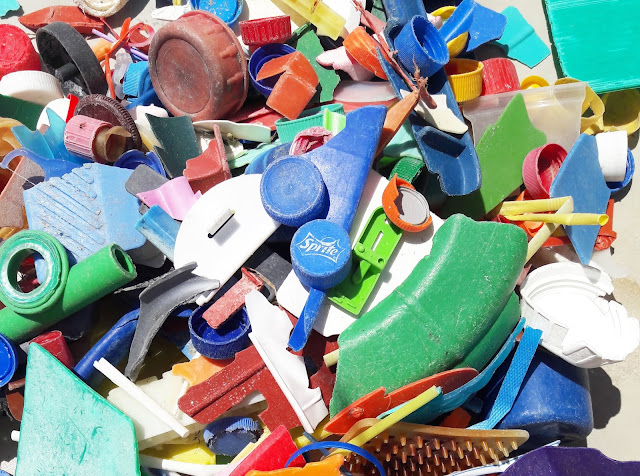
This project involved collecting plastic waste that had
been swept onto two different beaches in Heraklion. In just two hours, nearly
2,000 pieces of debris were collected. One million disposable plastic bottles are opened
every minute around the world and lids are the most common form
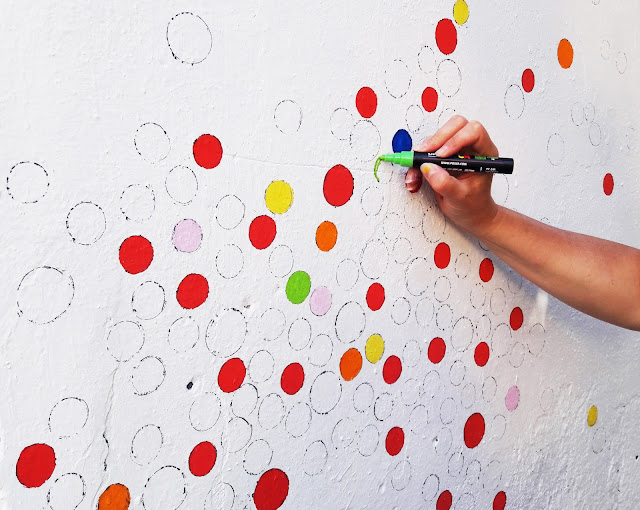
of plastic found on beaches. Using the lids from the collected rubbish, they
were printed and painted on a wall above a municipal dustbin to represent the
quantity, colours and nature of how they were found as scattered litter;
inappropriately disposed of. The lids themselves were tethered and hung in a
redundant window frame within the wall. The aim was to draw attention to the
global issue surrounding plastic waste being ‘cast away’ and becoming stranded
on beaches around the world.
Rubbish Prints
Rubbish Prints
Collograph Prints, Sheffield 2018
Images of flattened litter from the streets of Sheffield
are captured by inking them and pressing them in a hydraulic press, capturing
the detail of their function, texture and degradation.
Can Be Recycled Animation
Can Be Recycled
Stop frame Animation, Sheffield 2018
Single use drinks cans are usually made from aluminium. This is a material made by
mining bauxite, a mineral found
in tropical parts of the world. This is processed into alumina, which is then
smelted to produce aluminium alloy. It can be remelted and reused an infinite
number of times. without losing quality. Recycling aluminium uses 5% of the
energy needed to make primary aluminium. This stop frame animation made from
collograph prints of car crushed cans found on Sheffield streets, is aimed to
highlight the malleable, adaptable and valuable material that cans are made
from.
Subscribe to:
Posts (Atom)


